Serum immunoassays identify cartilage acidic protein (CRTAC1) as a biomarker of osteoarthritis
Introduction
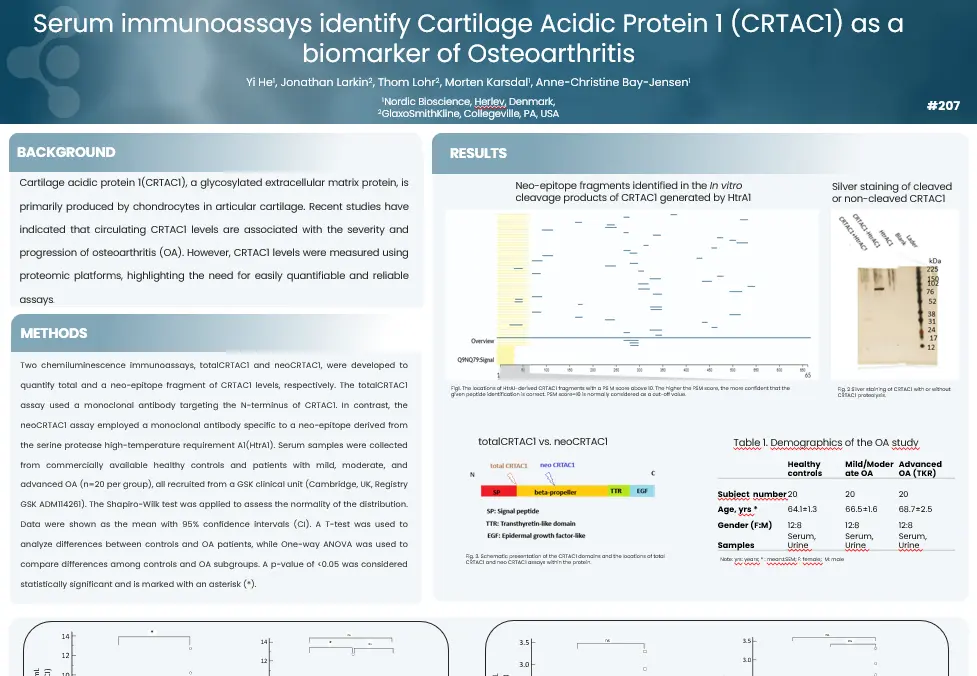
Cartilage acidic protein 1 (CRTAC1), a glycosylated extracellular matrix protein, is primarily produced by chondrocytes in articular cartilage. Recent studies have indicated that circulating CRTAC1 levels are associated with the severity and progression of osteoarthritis (OA). However, CRTAC1 levels were measured using proteomic platforms, highlighting the need for easily quantifiable and reliable assays.
This study validated CRTAC1 as a promising new biomarker for OA, utilizing easily quantifiable serum immunoassays. Differences in diagnostic performance between the total and neo-epitope CRTAC1 assays were observed. In conclusion, this study offers valuable insights into the role of CRTAC1 and its degradation process in Osteoarthritis.
Get in touch
Are you interested in exploring collaboration possibilities? Enter your information in the form and a representative will contact you shortly.
April 11th marks World Parkinson’s Day, which aims to spread awareness for the millions of patients with Parkinson’s.
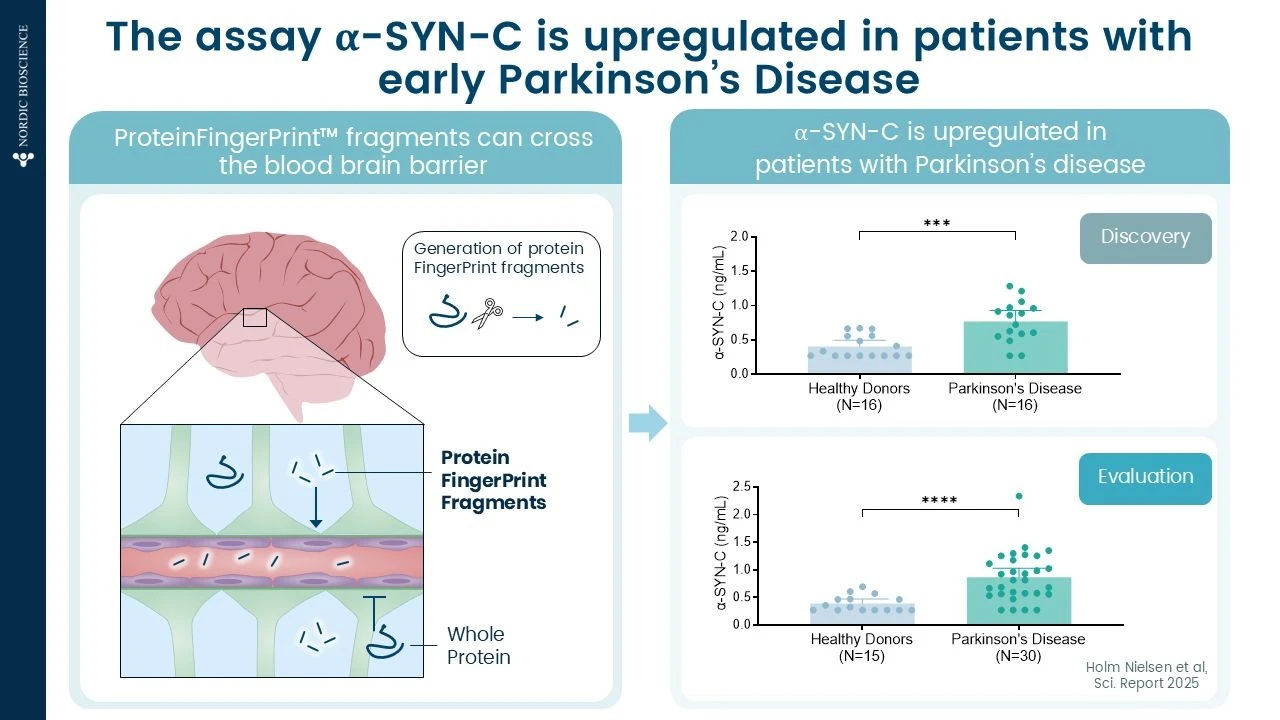
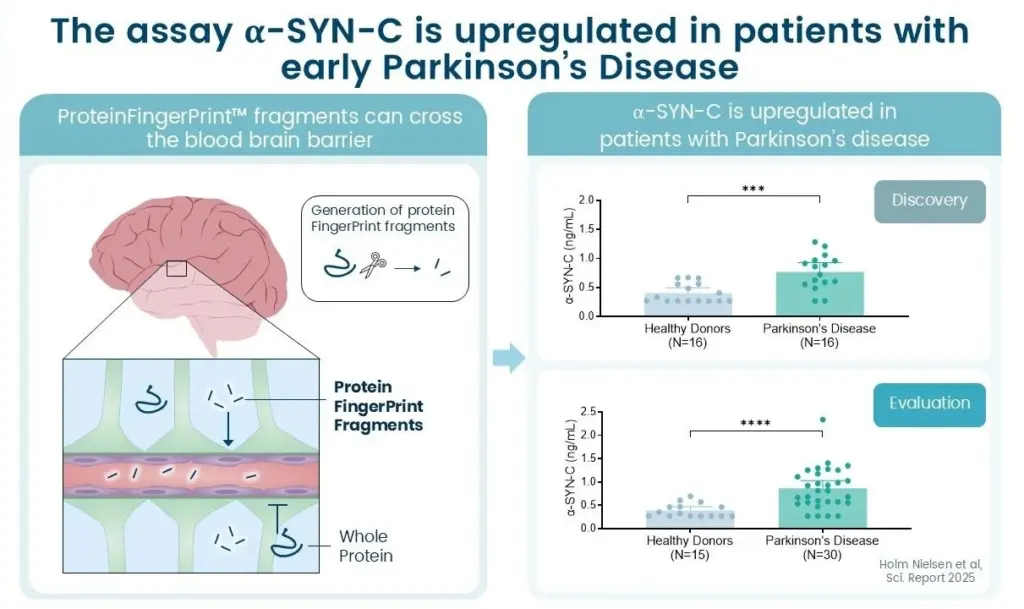
α-SYN-C is upregulated in patients with Parkinson’s disease
Parkinson’s is the fastest growing neurological disease and there currently is no cure. One of the main challenges in developing effective treatments for Parkinson’s disease is the need to diagnose patients early, identify those with rapid disease progression, and monitor treatment response through reliable indicators.
Nordic Bioscience has developed a blood-based biomarker targeting a pathological fragment of alpha-synuclein cleaved by Calpain-1, which aggregates into fibrils as part of the disease process. This biomarker has been shown to be upregulated in patients with Parkinson’s disease. Since this pathological fragment is generated before fibril aggregation occurs, we can identify patients early.
In our paper published in Scientific Reports, we describe the development and potential of this biomarker in two clinical cohorts of patients with Parkinson’s Disease.
Article: A fragment of Calpain-1 cleaved α-Synuclein quantified in serum is upregulated in patients with Parkinson’s disease
It can be a cumbersome clinical challenge to monitor subtle changes in collagen turnover in Systemic Sclerosis (SSc), a complex autoimmune condition marked by skin and organ fibrosis.
Systemic sclerosis (SSc) affects several tissues, leading to fibrotic tissue buildup of the skin and internal organs
In our latest open-access paper in Arthritis Research & Therapy, produced in collaboration with Dr. Satoshi Kubo, we reveal that although type VII collagen-an essential anchoring fibril in the skin’s basement membrane—is not directly linked to skin stiffness, its turnover is significantly elevated in SSc, even when disease activity appears low.
We have shown that the dynamics of type VII collagen remodeling can be quantified using the serological biomarker PRO-C7, measuring type VII collagen formation, and it’s counterpart measuring collagen degradation, C7M. By tracking these biomarkers, clinicians can identify patients with hidden yet active collagen turnover, allowing for more personalized treatment strategies and better monitoring of therapeutic responses.
Article: Accelerated Type VII collagen turnover in systemic sclerosis patients, reflected by serological neo-epitope fragment biomarkers
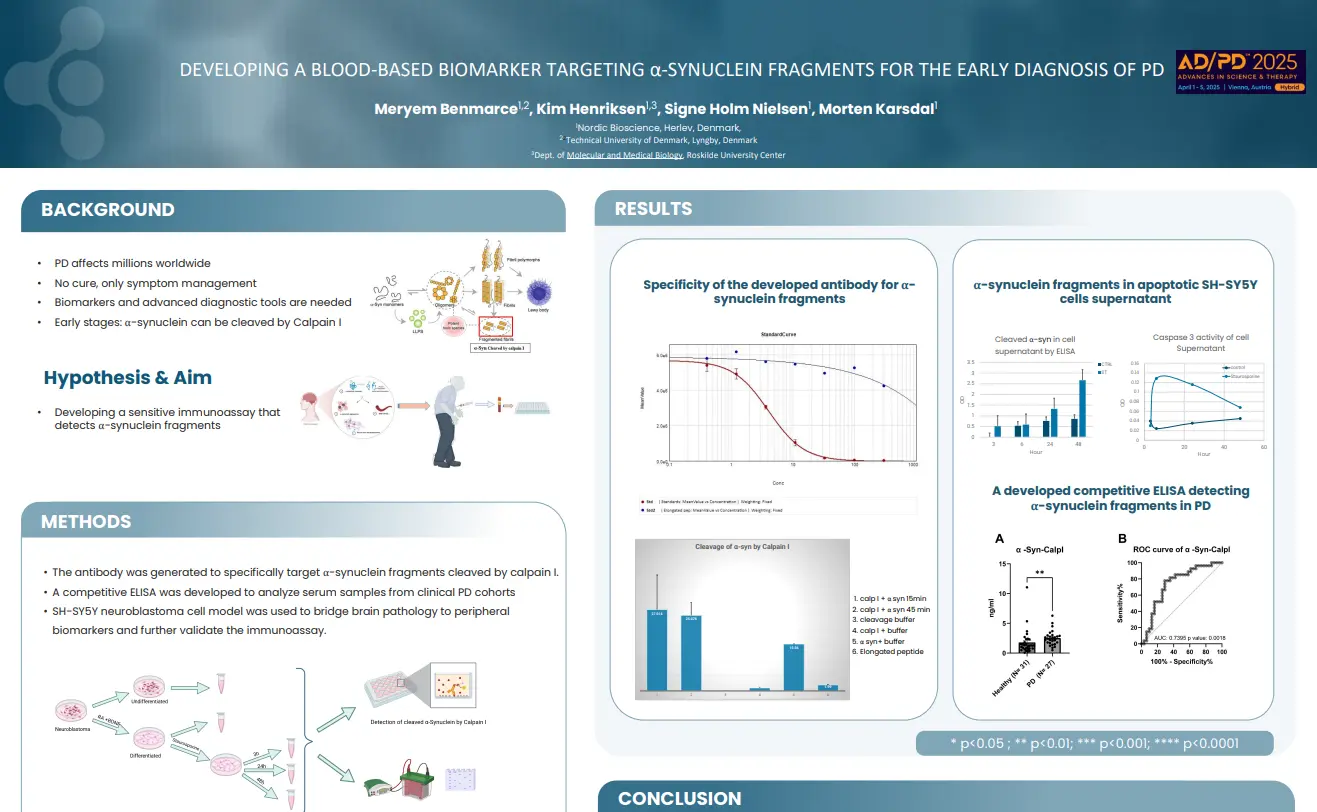
Developing a blood-based biomarker targeting α-synuclein fragments for the early diagnosis of PD
Introduction
Parkinson’s disease (PD) affects millions worldwide and currently has no cure. Treatments focus only on managing symptoms, explaining why there is a pressing need for biomarkers and advanced diagnostic tools to enable earlier detection and better disease management. In the early stages of PD, α-synuclein—can be cleaved by Calpain I, presenting a potential target for biomarker development.
The aim of this study was to develop a sensitive immunoassay that detects α-synuclein fragments.
α-Synuclein fragments cleaved by calpain I are key early drivers of Parkinson’s disease pathology. This blood-based biomarker holds promise for enabling early diagnosis and identifying patients who are likely to respond to treatment.
Get in touch
Are you interested in exploring collaboration possibilities? Enter your information in the form and a representative will contact you shortly.
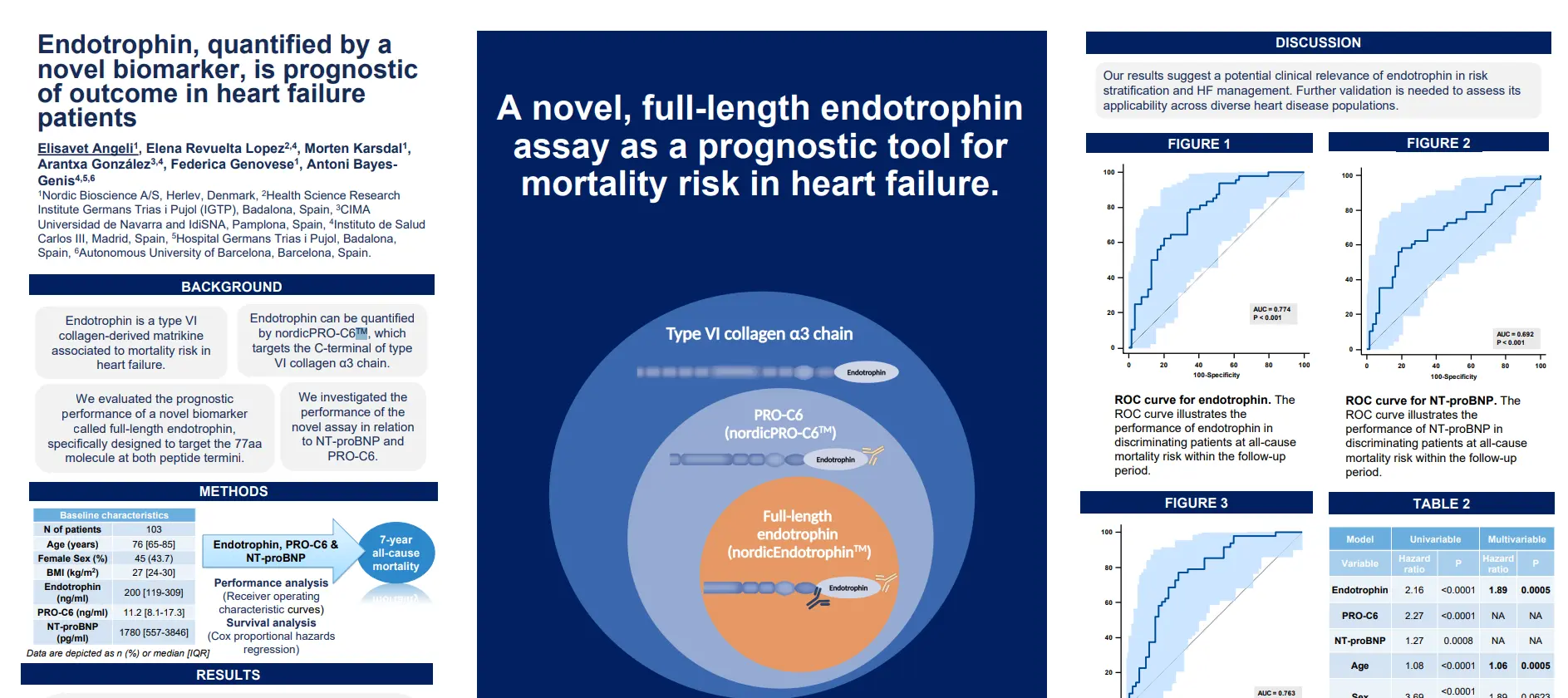
Endotrophin, quantified by a novel biomarker, is prognostic of outcome in heart failure patients
Introduction
NordicEndotrophin™ is a type VI collagen-derived matrikine associated to mortality risk in heart failure. It can be quantified by nordicPRO-C6™, which targets the C-terminal of type VI collagen α3 chain. In this study, we evaluated the prognostic performance of a novel biomarker called full-length nordicEndotrophin™, specifically designed to target the 77aa molecule at both peptide termini. We investigated the performance of the novel assay in relation to NT-proBNP and nordicPRO-C6™.
This study presents the novel biomarker of full-length nordicEndotrophin™ demonstrating comparable performance to NT-proBNP and nordicPRO-C6™ in predicting mortality risk in HF patients. The biomarker’s prognostic value remains robust even after adjusting for relevant risk factors.
Get in touch
Are you interested in exploring collaboration possibilities? Enter your information in the form and a representative will contact you shortly.
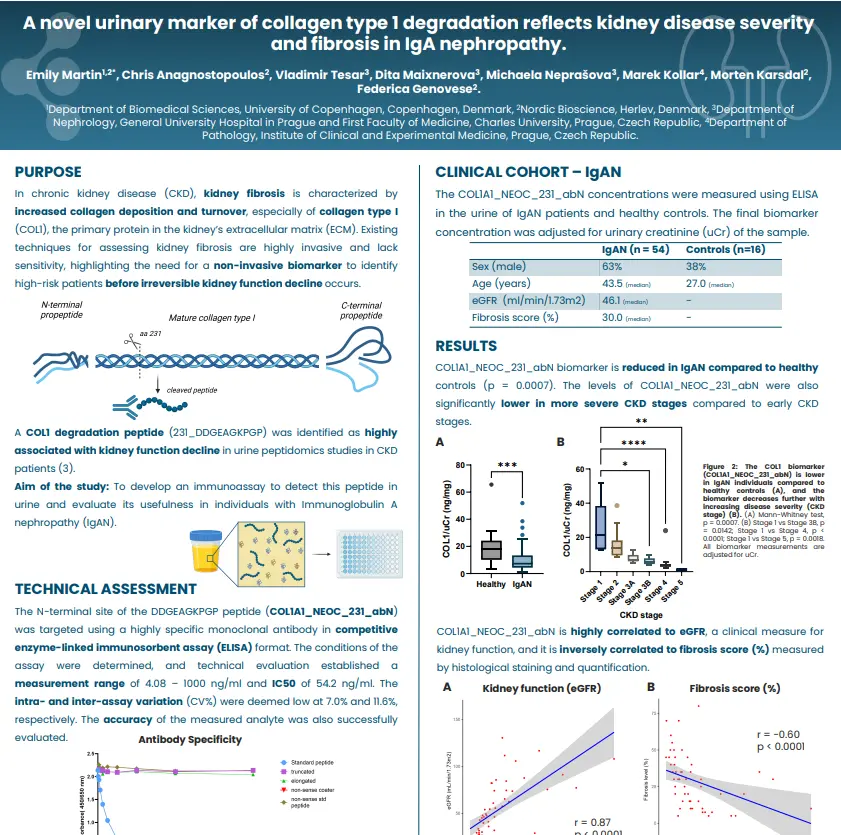
A novel urinary marker of collagen type 1 degradation reflects kidney disease severity and fibrosis in IgA nephropathy.
Introduction
In chronic kidney disease (CKD), kidney fibrosis is characterized by increased collagen deposition and turnover, especially of collagen type I (COL1), the primary protein in the kidney’s extracellular matrix (ECM). Existing techniques for assessing kidney fibrosis are highly invasive and lack sensitivity, highlighting the need for a non-invasive biomarker to identify high-risk patients before irreversible kidney function decline occurA COL1 degradation peptide (231_DDGEAGKPGP) was identified as highly associated with kidney function decline in urine peptidomics studies in CKD patients (3).
The aim of this study was to develop an immunoassay to detect this peptide in urine and evaluate its usefulness in individuals with Immunoglobulin A nephropathy (IgAN).
We developed a novel and robust urinary assay which showed potential as a non-invasive biomarker of kidney disease severity and fibrosis in IgAN. It will be of interest to evaluate its prognostic potential in appropriate kidney disease cohorts and further in other organ diseases to understand the specificity of the biomarker to CKD.
Get in touch
Are you interested in exploring collaboration possibilities? Enter your information in the form and a representative will contact you shortly.
We have highlighted some our publications that we and our collaborators worked on in the first quarter of 2024—in no particular order. We invite you to browse and read according to your interests!
Oncology
Fibroblast activation protein (FAP) is almost exclusively expressed in pathological conditions including multiple types of fibrosis and cancers, making it an optimal target for treatment.
Treatment strategies utilizing the unique proteolytic activity of FAP are emerging, thus emphasizing the importance of biomarkers to directly assess FAP activity.
CWe developed a non-invasive quantification tool for FAP-activity, specifically generated through FAP-mediated cleavage (C3F) for selection and monitoring of patients in FAP-related clinical trials.
Novel treatments for Alzheimer’s Disease are intensely sought; however, there is a dire lack of good biomarkers identifying the population with active disease progression, i.e. those in need of treatment.
We measured our Tau-A and Tau-C assays in a clinical cohort of patients with well-characterized Alzheimer’s Disease, and we observed that Tau-A was related to the CSF-levels of Aβ1-42, while Tau-C levels were indicative of fast progression, and as such identified a population of great interest.
We explored the involvement of the extracellular matrix (ECM) in various cardiomyopathies and its impact on myocardial stiffness and fibrosis. We also discussed the potential of ECM fragments for early diagnosis, prognosis, and risk stratification.
Cardiomyopathies constitute a diverse group of disorders characterized by fibrosis, ultimately leading to heart failure. Utilizing ECM biomarkers could enhance diagnosis and guide personalized therapies targeting fibrosis.
We investigated whether a degradation fragment of collagen type III (C3M) correlated with markers of inflammation and endothelial dysfunction and whether C3M was a risk marker for progression of chronic kidney disease (CKD)in persons with type 2 diabetes and microalbuminuria.
Higher serum C3M is a risk marker for CKD progression and correlates with markers of inflammation in persons with type 2 diabetes. Moreover, a doubling of serum C3M was associated with CKD progression (with mortality as competing risk) after adjustment for conventional risk factors.
In our first rheumatology publication, we investigated M6495, a new drug targeting ADAMTS-5, in healthy volunteers and osteoarthritis patients.
M6495 was safe and well-tolerated at doses up to 300mg. It significantly reduced a key biomarker of cartilage breakdown, suggesting potential to slow disease progression.
In the second study explored a new biomarker for response to Tocilizumab, a treatment for rheumatoid arthritis. Measuring type VI collagen degradation (C6M) identified patients who benefited more from the drug.
This approach has potential to personalize treatment and improve outcomes for RA patients.
In our third rheumatology publication, highlighted the need for better ways to classify osteoarthritis (OA). Current treatments only manage symptoms, and a deeper understanding of the disease is crucial.
We propose using a panel of biochemical markers to define different OA subtypes (endotypes).
We are changing people’s lives and making an impact!
“I hope this year will be as productive as last year! Congratulations to Team Nordic,” said Morten Karsdal, CEO of Nordic Bioscience, as we close out 2021 and head into 2022. “Thank you for your commitment and support to our mission: to change people’s lives through precision medicine and serological quantification of the extracellular matrix (ECM), enabled by high-precision instrumentation,” Morten Karsdal emphasized.
Nordic Bioscience has published a total of 59 publications in 2021, exclusively in peer-reviewed journals, with an average impact factor of 6.62, which shows the impact Nordic Bioscience scientists are leaving in the field. This means that quantity and quality go hand in hand, as an impact factor above 5 is a very good distinction. Even more, many of these 59 publications have an impact factor above 10 or even 20.
Nordic Bioscience’s research group is highly regarded in its field and a leader in extracellular matrix (ECM) science and quantification, proving that the company’s efforts are having an impact.
“When we visited customers in December during our normal pharma tour,” says Morten Karsdal, “I often heard how impressed our customers were with the interaction of our senior scientists and directors and the seamless coordination of the lab. “It is clear that we are all making a difference by trying to do things a little bit better every day,” the CEO added.
These successes are the culmination of a year-long team effort. The publications are based on data, and all data start with an idea for a biomarker. Assay development, assay production, assay validation, assay measurements, biobank samples, legal contracts, quality control, data reporting, and so on: all these pieces of the puzzle are required to produce publications that demonstrate value to patients and science.
Finally, the 3rd edition of Nordic Bioscience’s collagen book will be published in 2022, after the 2nd edition was downloaded 9000 times.
Get in touch
Are you interested in exploring collaboration possibilities? Enter your information in the form and a representative will contact you shortly.
Nordic Bioscience digest of the Best of 2022 publication series
In 2022, our scientific teams have once again worked incredibly hard to advance our technologies to better benefit patients in need. With more than 60 publications, we have published an average of more than 5 articles per month this year.
We have put together the best of 2022 for you from our various focal points—in no particular order. We invite you to browse and read according to your interests!
Respiratory
Novel treatments for idiopathic pulmonary fibrosis (IPF) are needed to combat this devastating disease.
To investigate the antifibrotic effect of novel compounds and increase the chances of success in clinical trials, blood-based biomarkers may already be introduced at early stages of development.
Conventional serum calprotectin biomarkers are often not as clinically useful as the fecal versions because the short half-life of calprotectin in blood reduces the window in which the current serum calprotectin ELISA assay can detect calprotectin dimer protein.
CPa9-HNE ELISA has emerged as a novel serum calprotectin biomarker with significant clinical potential as a biomarker for patients with IBD to monitor disease activity and neutrophil activity.
Monitoring changes in the extracellular matrix during liver fibrosis is of great interest. Biomarkers to assess fibrogenesis already exist, but biomarkers of fibrosis resolution have not been validated.
These biomarkers would be equally valuable for understanding disease progression or the mechanism of a particular intervention, and for understanding the potential induction of hepatic fibrosis resolution.
Identification of biomarkers associated with psoriatic arthritis (PsA) disease and their potential as predictors of response to treatment are unmet needs in PsA.
The aim of the study was to investigate the association of serum levels of tissue turnover biomarkers with PsA disease phenotypes and response to Guselkumab treatment.
All agree that osteoarthritis (OA) is a heterogeneous disease – drugs in development fail because there is no approved way to segregate patients to give them targeted treatment.
Endotyping is necessary to understand the pathogenesis that drives the disease in individual patients. In the APPROACH consortium, we have measured biochemical markers that reflect the pathogenesis of different tissue compartments affected by the disease.
A persistent problem remains unresolved in heart failure with preserved ejection fraction – targeted treatment for highly heterogeneous patients.
This heterogeneity can be the cause of the lack of response to treatment in clinical trials, making it difficult for trials to succeed. The field needs better actionable biomarkers capable of finding the patients most in need of treatment – and that starts with PRO-C6.
Pancreatic cancer is an extremely lethal and fibrotic cancer disease. Novel tools such as biomarkers and preclinical models that can improve understanding of tumor fibrosis biology, drug development, and disease progression are urgently needed.
In this publication, we established a pseudo-3D in vitro pancreatic CAF model in combination with clinical collagen biomarkers (PRO-C3 and PRO-C6) as a translational screening tool for antifibrotic drugs.
Nordic Bioscience digest of the Best of 2023 publication series
2023 – a year of a series of scientific successes for Nordic! Our scientific teams have worked incredibly hard to advance our technologies to better benefit patients in need. With close to 60 publications, we averaged at least 5 articles per month – just like last year. We have put together the best of 2023 for you from our various focal points—in no particular order. We invite you to browse and read according to your interests!
New biomarkers are crucial for identifying fast-progressing idiopathic pulmonary fibrosis (IPF) patients. We evaluated the serological value of two vimentin neo-epitopes, VIM and VICM, in IPF.
While both originate from the same fragment, VIM measures vimentin degradation, and VICM reflects macrophage activity through citrullination. Notably, unlike VIM, VICM demonstrated significant prognostic value, effectively distinguishing fast-progressing from non-progressing IPF patients at diagnosis.
This paper highlights the potential of biomarkers to expedite drug development, emphasizing their role as early indicators for improved clinical response, enhanced patient safety, and personalized medicine.
We explore lessons learned by the EU IMI2-funded LITMUS consortium in their interactions with regulatory agencies, underscoring the significance of sharing such knowledge with the scientific community to increase the likelihood of qualifying relevant biomarkers and facilitating common understanding and support in decision-making frameworks.
This publication introduces a novel approach for nonalcoholic fatty liver disease (NAFLD) by identifying a “high-risk, high-fibrogenesis” patient endotype using collagen formation biomarkers.
Characterized by elevated fibroblast activity, this endotype responds well to a very low-calorie diet, showing a significant reduction in collagen fibrogenesis with weight loss. Quantifying fibrogenesis biomarkers allows predicting treatment response at baseline.
Skin tissue remodeling is vital for maintaining homeostasis but can be disrupted in conditions like atopic dermatitis, psoriasis, and hidradenitis suppurativa. Type VI collagen is crucial for ECM assembly in human dermal fibroblasts.
Specific fragments of type VI collagen can serve as blood biomarkers for dermatological conditions. Quantifying the levels of type VI collagen inpatients with dermatological disorders could prove to be a valuable tool for both patient identification and drug development.
The pathogenesis of axial spondyloarthritis (axSpA) involves tumor necrosis factor (TNF)-α-induced joint inflammation. However, choosing optimal treatments for axSpA in a timely and non-invasive manner remains a challenge in clinical practice.
Blood-based biomarkers present a cost-effective and accessible solution. Exploring ECM biomarkers as potential pharmaco-dynamic markers may aid in predicting and monitoring TNF-α inhibitor treatment responses in axSpA patients. This research also sheds light on the development of new effective therapeutic strategies.
Recent evidence suggests Empagliflozin may have anti-fibrotic effects, notably reducing type I and III collagen (PINP and PRO-C3). Lower levels of type VI collagen (PRO-C6) are associated with milder heart failure outcomes but increased risks of hospitalization, mortality, and renal complications.
Accurate assessment of extracellular matrix remodeling is crucial for precise heart failure patient endotype identification. Other studies reveal a 12.4% and 9.2% increase in cardiovascular or all-cause mortality risk per 1 ng/ml rise in PRO-C6.
Our study explores tumor collagen quantity and quality, emphasizing cancer-associated fibroblasts (CAFs) and their role in tumor fibrosis. We connect serological collagen biomarkers to specific CAF subtypes within the tumor microenvironment, building on our FDA-supported letter of support for the initial serological biomarker for tumor fibrosis.
The unique collagen profiles linked to CAF subtypes present potential avenues for discovering new cancer biomarkers and therapeutic targets.