Psoriasis

Biomarkers for investigating psoriasis

Psoriasis is a chronic inflammatory skin disease, characterized by excessive tissue remodeling and immune cell activity. Psoriasis manifests in scaly reddish plaques on frequently chafed body parts, leading to itching and pain, which may severely affect the patient’s quality of life.

Tissue-specific biomarkers, quantifying and monitoring epidermal damage, dermal damage and immune cell activity, provide key advantages when we want to understand the disease mechanisms. Utilizing such biomarkers can help monitor disease activity and predict a therapy with greater reliability of response.

Biomarker upregulation reveals psoriasis progression

A balanced extracellular matrix (ECM) is necessary to preserve skin integrity and tissue homeostasis. Several ECM components of the dermis, epidermis, and epidermal basement membrane, reflecting the individual skin compartments are remodeled during psoriasis progression.

Biomarkers related to psoriasis pathogenesis are crucial for use in clinical trials, but also to advance the knowledge of the biological complexity and heterogeneity behind psoriasis.

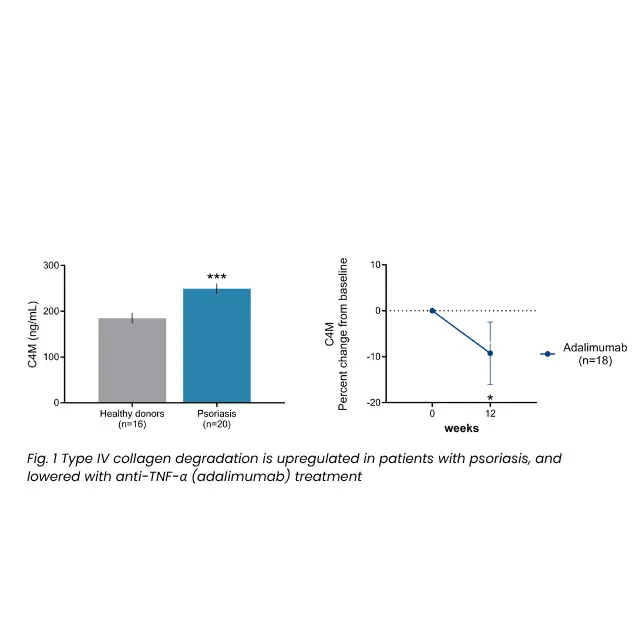
The biomarkers utility in the disease is depicted by PRO-C3 (nordicPRO-C3™) (Activated dermal fibroblasts; Formation of type III collagen) and CPa9-HNE (nordicCPa9™, a biomarker of neutrophil activity; S100A9 degraded by human neutrophil elastase), in Figure 1. Both biomarkers are upregulated in patients with psoriasis.

The Nordic ProteinFingerPrint Technology™ in Psoriasis

Watch this video to learn how our technology can help advance Psoriasis research. A simple blood sample can be quantified by the Protein Fingerprint Technology and be used as a sophisticated biomarker tool for tailoring treatment solutions, predicting and monitoring disease progression and treatment response.

About psoriasis

  • Psoriasis is a common, chronic, immune-mediated disease manifested in the skin, affecting 2-3% of the population.


    It appears in early adulthood and is a lifelong condition. Up to 90% of all psoriasis patients have plaque psoriasis, which is characterized by “plaques” of the skin, that are mainly found on the scalp, knees, elbows, trunk, and limbs causing itching and pain.


  • Psoriasis is diagnosed by medical examination and can upon diagnosis be treated accordingly.


    The first in-line treatments include topical corticosteroids, while severe cases may receive biologics and oral treatments.

  • The main component of the skin is collagens, which are remodeled as a part of the normal homeostasis of the skin.


    In psoriasis, there is an imbalance of tissue build-up and tissue breakdown, resulting in a net degradation of the tissue. 


    Nordic ProteinFingerPrint™ biomarkers can quantify skin tissue turnover directly in a serum sample and serve as a liquid biopsy.

Get in touch

Are you interested in exploring collaboration possibilities?
Enter your information in the form and a representative will contact you shortly.

    Nordic Bioscience’s assays and services are research use only products and services and do not qualify for medical or diagnostic purposes.