What are unicorn biomarkers?

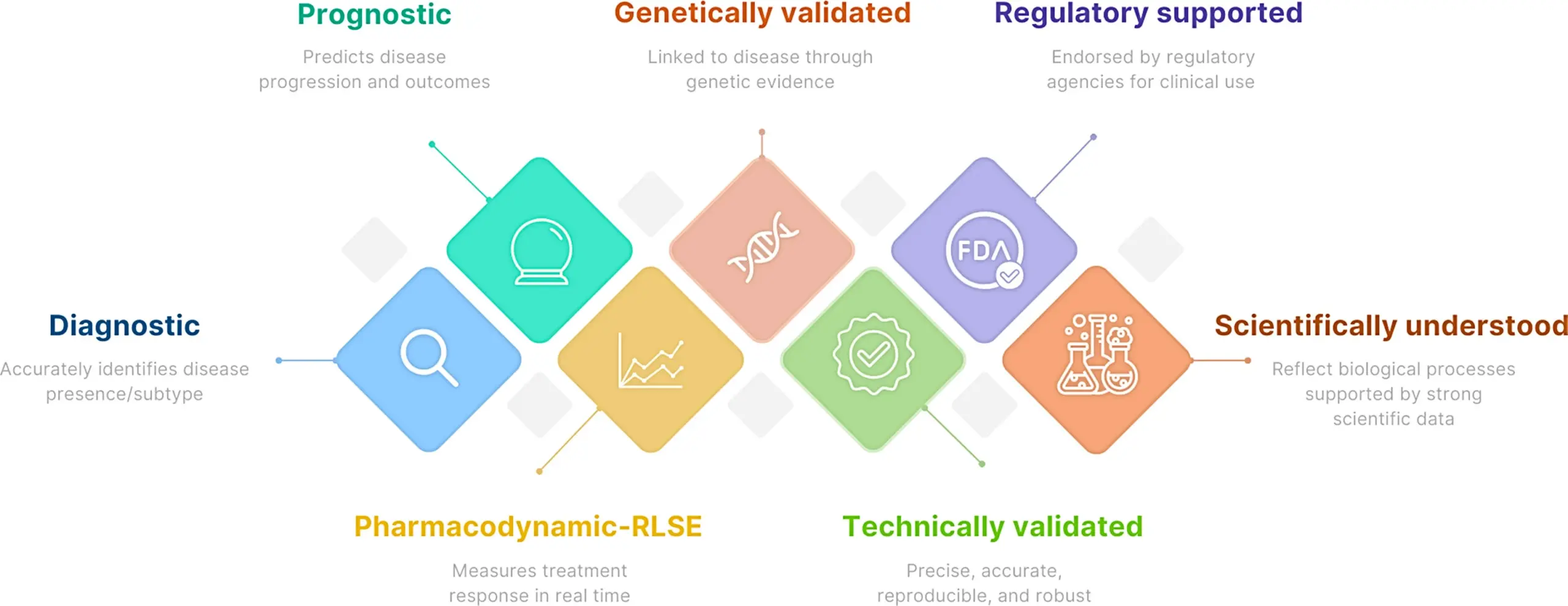
Unicorn Biomarkers are rare markers that fulfil diagnostic, prognostic, and pharmacodynamic functions and may qualify as reasonably likely or validated surrogate endpoints. They have been integrated into clinical guidelines and are widely accepted and utilized in clinical practice, having demonstrated clinical and regulatory utility through extensive validation and real-world evidence. A unicorn biomarker has also shown consistency and reliability across different laboratories and settings.

The concept of a unicorn biomarker was recently formalized in an expert opinion published in the Journal of Hepatology (IF 40 as of August 2026), which introduced the unicorn biomarker as a higher standard for biomarker development. To achieve unicorn biomarker status, a biomarker would be expected to fulfil most or all of these criteria across clearly defined Contexts of Use.

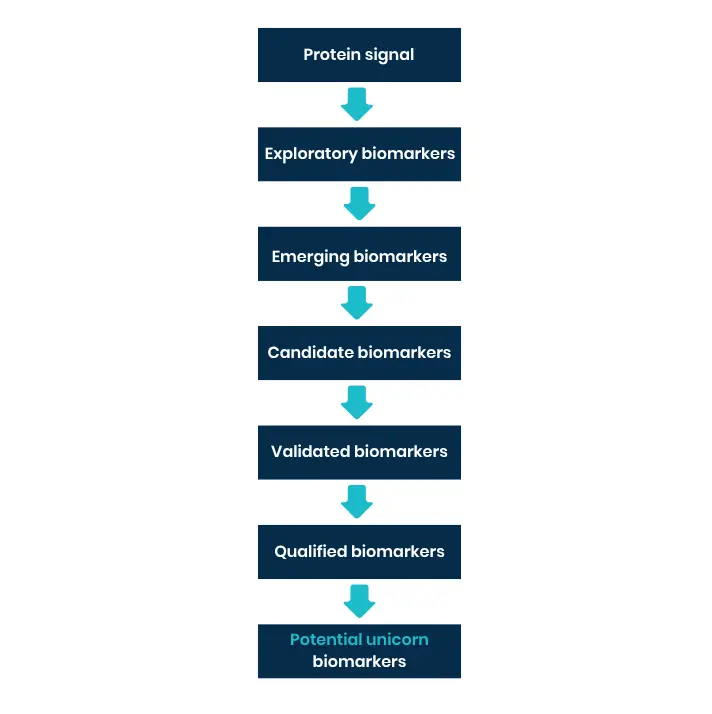
From discovery to unicorn status – the path of unicorn biomarkers

Many newly identified proteins and other biological signature markers are referred to as biomarkers despite limited evidence of their clinical relevance. While such findings may present promising protein signals, a protein analyte should not automatically be considered a biomarker. Distinguishing between protein signals and biomarkers is therefore essential.

Progression from an initial protein signal to a validated biomarker requires the accumulation of biological, analytical, and clinical evidence, together with a clearly defined context of use. The stages illustrated in the figure represent this development pathway. Although these categories should not be viewed as rigid, they provide a framework for distinguishing exploratory findings from biomarkers that have achieved increasing levels of validation, qualification, and clinical utility. While only a rare few biomarkers may ultimately progress towards unicorn biomarker status, the framework serves as a guide for biomarker development and a means of evaluating progress toward greater clinical utility.

How does a biomarker become a unicorn?

Establishing  a unicorn  biomarker status requires undergoing multiple studies, with results ideally reported in peer-reviewed publications, and documentation of rigorous technical validation across diverse contexts of use and in different well-defined patient populations. In addition to meeting these high standards, only biomarkers offering Contexts of Use (CoU) utility across diagnostic, prognostic, and pharmacodynamic/monitoring  applicability  can be considered unicorn biomarkers. Context of Use defines the specific purpose of a biomarker, the population in which it is applied and the decision it is intended to support. A biomarker may perform well for prognosis but be unsuitable for treatment monitoring, or vice versa.

Importantly, different CoUs require distinct performance characteristics. For example, diagnostic and prognostic biomarkers should be stable, reliably distinguishing disease presence or predicting disease progression. In contrast, pharmacodynamic biomarkers must be dynamic and sensitive to early changes in disease activity in response to treatment, for them to be used for dose selection in early studies. This complexity is well reflected in the technical CLSI guidelines,  which require a deep understanding of what may confound the levels of the biomarker.  

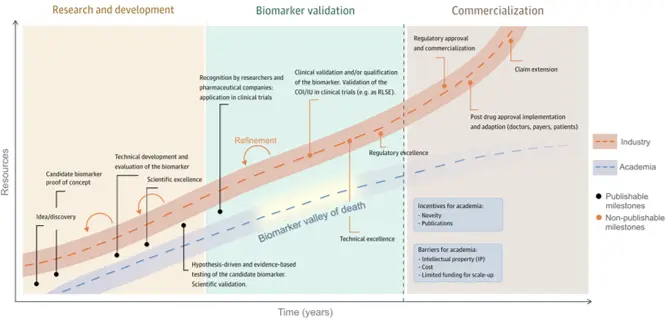
The biomarker valley of death – Why do most biomarkers fail?

A promising biological association is only the beginning of biomarker development. Before a candidate can support clinical or drug-development decisions, it must undergo assay refinement, analytical validation, clinical validation and evaluation within a clearly defined Context of Use.

Many candidates stall between discovery and implementation. Common reasons include insufficient technical robustness, limited evidence from independent or representative cohorts, unclear biological relevance, lack of regulatory alignment and no viable path to scalable implementation.

This translational gap is described as the biomarker valley of death. The work required to cross it is often costly, technically demanding and less visible than the original discovery, but it is essential for turning a promising signal into a reliable tool.


HbA1c- An example of a true unicorn biomarker

One example of a unicorn biomarker is HbA1c, a glycated form of haemoglobin, which can be applied in diabetes patients. It is a diagnostic, pharmacodynamic and prognostic biomarker and has been investigated and sciential understood since the 60s. It has been validated and regulatory supported by the EMA and ADA.  It therefore fulfils all the requirements needed to define it as a unicorn biomarker and acts as an example to show how difficult it is to obtain this title. 

Although it remains an inspiring goal to discover true “unicorn biomarkers”, it is equally important to recognize early in development that not all biomarkers are destined to achieve such multi-functionality. Some will find their strength within a single, clearly defined Context of Use, while others may demonstrate the rare potential to evolve toward broader utility over time. 

Does every biomarker need to become a Unicorn?

No. A biomarker can provide substantial value within one clearly defined Context of Use. A strong prognostic biomarker, for example, does not become unimportant because it lacks pharmacodynamic utility. Unicorn Biomarkers are deliberately rare. The framework should help researchers understand the evidence and development stage of a biomarker, but not dismiss useful limited-purpose tools.

How can Unicorn biomarkers support your trials?

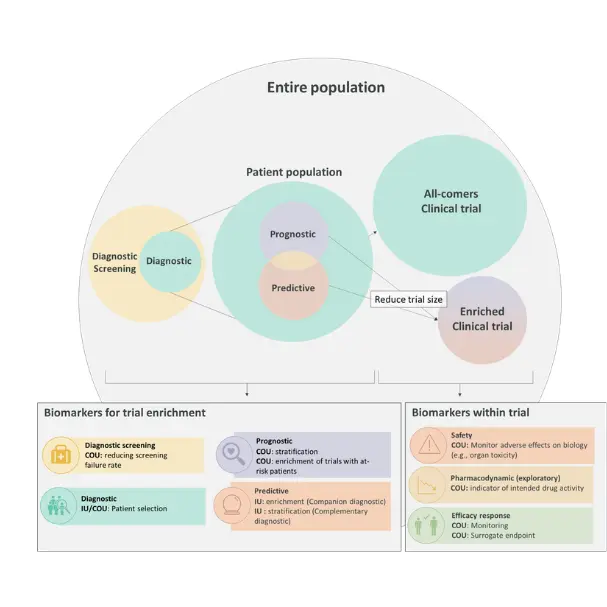
Unicorn biomarkers are very valuable because they simultaneously serve diagnostic, prognostic, and pharmacodynamic/monitoring roles, as well as both technical validation and regulatory requirements. Thereby they provide a large amount of information rather than one single biomarker or a wide array of proteomics. 

Patient selection and enrichment
Diagnostic and prognostic biomarkers can identify patients with the relevant disease biology, stage or risk profile, reducing heterogeneity in a clinical trial.

  • Proof of mechanism and dose selection
    Pharmacodynamic biomarkers can show whether a therapy is affecting its intended biological pathway and help inform dose selection during early development.
  • Earlier treatment-response assessment
    Dynamic biomarkers may change before conventional clinical outcomes become visible, supporting earlier go/no-go decisions.
  • Treatment monitoring
    Repeated measurements can help distinguish responders from non-responders and characterize the durability of a biological response.
  • Potential surrogate endpoints
    When changes in a biomarker are sufficiently linked to clinical benefit, it may progress toward use as a reasonably likely or validated surrogate endpoint.
  • Broader therapeutic profiling
    A panel of biologically specific biomarkers can assess efficacy in the primary target organ and potential benefits or adverse effects in other tissues.

What does FDA consider for a new surrogate endpoint?

For biomarkers being considered as new surrogate endpoints, early regulatory discussion can help determine whether the available evidence is sufficient and where important knowledge gaps remain. FDA’s Type C meeting framework highlights the questions sponsors should consider when discussing a new surrogate endpoint.

FDA consideration Key question
Clinical outcome What clinical outcome is the surrogate endpoint intended to predict?
Rationale for using a surrogate endpoint Why use the surrogate rather than measuring the clinical outcome directly?
Evidence supporting the relationship What evidence links changes in the biomarker to the clinical outcome?
Causal pathway How does the surrogate endpoint relate to the biological pathway driving disease?
Clinically relevant change What magnitude and timing of change would predict a meaningful clinical outcome?
Consistency across populations Does it perform consistently across relevant patient subgroups?
Treatment-induced change Is a treatment-induced change in the biomarker predictive of a change in clinical outcome?
Measurement reliability Can the endpoint be measured reliably and reproducibly?

The FDA document Considerations for Discussion of a New Surrogate Endpoint(s) at a Type C PDUFA Meeting Request provides the complete set of considerations for sponsors preparing these discussions.

Unicorn biomarkers at Nordic Bioscience

At Nordic Bioscience, we strive to bring our biomarkers to true unicorn biomarker quality. For example, our ongoing efforts with NordicPRO-C3™ highlight a fantastic potential to become one. 

Having undergone rigorous testing, regulatory approvals, and earning an FDA Letter of Support, NordicPRO-C3™ is one of our flagship products available on the Elecsys® Roche cobas analysers. This unicorn candidate is an in vitro quantitative immunoassay that measures PRO-C3 in human serum/plasma to assess the severity of hepatic fibrosis in patients with evidence or signs of metabolic dysfunction-associated steatotic liver disease (MASLD) and other chronic liver diseases. 

To illustrate the difficulty of reaching unicorn status, Nordic Bioscience originated this biomarker over 15 years ago and then co-developed the assay with Roche Diagnostics, supporting translation of fibrosis biomarkers from clinical research into regulated clinical use. Over 100 publications feature PRO-C3 documenting its scientific, pharmacodynamic, prognostic, and diagnostics capabilities, paving its way to become a true unicorn biomarker.

FAQ about unicorn biomarkers

  • The biomarker needs to be directly linked to the proven critical path of the disease in question.

  • Due to a close connection with the underlying disease biology, changes in unicorn biomarker levels typically occur earlier than changes in organ function. This allows for the detection of pharmacodynamic effects sooner and in fewer patients, enabling faster and more efficient trials. Introducing new and clinically relevant RLSEs can alleviate the operational, patient, and cost burdens of Phase 3 trials.

  • Unicorn biomarkers, consequent to their extensive literature, rely on multiple sources of evidence, both randomized clinical trials (rCTs) and epidemiologic studies with outcomes, and preferably including cellular studies. They are often studied in randomized controlled trials to predict clinical outcomes and track pharmacodynamic changes with treatments, ideally across different mechanisms of action to support the generalizability of the biomarker, thus being treatment-agnostic.

  • Unicorn biomarkers, consequent to their prognostic, diagnostic and pharmacodynamic performance criteria, reflect the underlying disease biology and often capture downstream processes that drive disease progression. For example, collagen formation and degradation biomarkers quantify fibrosis balance, a disease pathology that may be shared by more than 50 chronic diseases. Because fibrosis drives organ dysfunction and poor clinical outcomes, biomarkers related to fibrogenesis and fibrolysis provide a scientifically understood and broadly applicable potential surrogate endpoint across diseases where fibrosis is causal. Consistent with this, fibrosis and accumulation of collagens are on the causal pathway in liver fibrosis, and in fibrotic diseases more broadly.

  • The magnitude and timing of change are context-specific and depend on the biological pathway, mechanism of action of the therapy, and disease progression rate. Typically, unicorn biomarkers are sensitive to therapeutic response before clinical outcomes manifest, as they reflect the underlying disease biology, making them valuable tools for early decision-making. The extent and timing of biomarker changes are typically evaluated through longitudinal and interventional studies (phase II and III) conducted during the development of a unicorn biomarker and its utilization in industry-sponsored clinical trials.

Get in touch

Are you interested in exploring collaboration possibilities?
Enter your information in the form and a representative will contact you shortly.