Most biomarker candidates die in the valley of death. What made PRO-C3 different?
October 6, 2026
Biomarker discovery has accelerated dramatically, but clinically viable products rarely follow. Thousands of protein signals are associated with disease every year, yet, relatively few become reliable tools for clinical development or patient management. Many stall in the biomarker valley of death: the long and resource-intensive space between initial discovery and validated clinical utility.
High-throughput omics and proteomics can identify thousands of disease-associated signals. But an association alone does not make a measurement an actionable biomarker. Biological specificity, analytical performance, clinical evidence and a clearly defined Context of Use must follow.
A new expert opinion in the Journal of Hepatology (IF 40 as of August 2026) proposes a higher standard. While the paper takes the liver field as an example, it’s findings are applicable to most diseases. It introduces the concept of the unicorn biomarker: a rare biomarker with diagnostic, prognostic and pharmacodynamic utility, supported by rigorous technical, clinical and regulatory development. PRO-C3, invented by Nordic Bioscience, is highlighted as one of the potential unicorn biomarkers approaching this standard.
Most candidates die in the biomarker valley of death
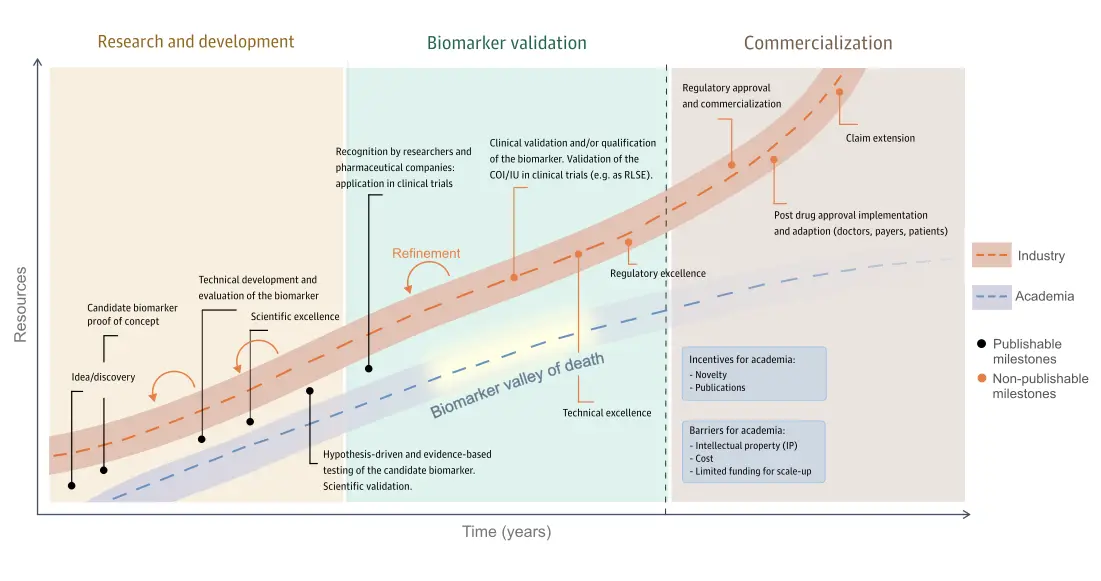
Discovering a promising protein signal is only the beginning. To progress toward clinical utility, a candidate must undergo technical development, scientific and clinical validation, regulatory alignment and, ultimately, implementation on a reliable and scalable platform. Many candidates never progress beyond discovery or early validation, while others stall when the cost and technical requirements increase.
The journey begins with research and development, where a biomarker is discovered through scientific hypothesis testing. Most biomarkers remain in research and development, as advancing further requires investment in technical excellence and quality control. The second stage is the biomarker validation stage where biomarkers are validated in clinical trials and technical performance on the final assay design is rigorously tested. This phase is often called the “biomarker valley of death” because the work is costly, technically demanding, and rarely publishable, causing many candidates to stall.
The final stage is commercialization, which focuses on achieving regulatory approval for specific contexts of use (CoUs) or intended uses (IUs) and implementing marketing strategies to generate a return on the investment. Here, academia and industry collaborate to validate, adopt, market, and implement the biomarker for clinical applications.
What does it take to become Unicorn biomarker?
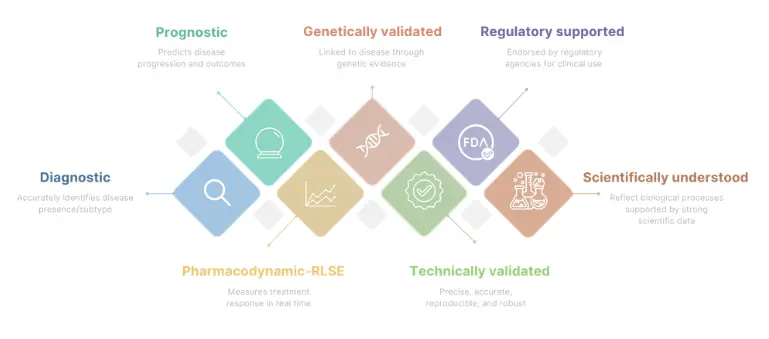
Unicorn biomarkers are rare and valuable, as they must fulfill various requirements (Fig. 3). Unlike biomarkers that serve a single purpose, they provide value across multiple stages of research and clinical development. They combine diagnostic utility, prognostic utility and pharmacodynamic utility, which is a combination of requirements that can be challenging because the criteria often is conflicting. While diagnostic and prognostic biomarkers must reliably reflect stable disease characteristics, pharmacodynamic biomarkers need to be sufficiently sensitive and dynamic to detect treatment-induced changes.
Beyond clinical utility, a unicorn biomarker must also be scientifically understood, technically validated to ensure reliable and reproducible results, and regulatory supported to enable its use in clinical development and, ultimately, patient care. Only when these scientific, technical, clinical, and regulatory criteria come together can a biomarker be considered a true unicorn biomarker.
Why the exact protein measurement matters
Proteins exist in different fragments, modified forms, or structural regions, each reflecting different biological processes. As a result, two measurements of the same protein may not necessarily provide the same clinical or biological insight if they target different parts of the molecule.
This is why the exact molecular target matters in biomarker development. The value of a biomarker does not only depend on identifying the right protein, but on measuring the right part of that protein in the right biological and clinical context.
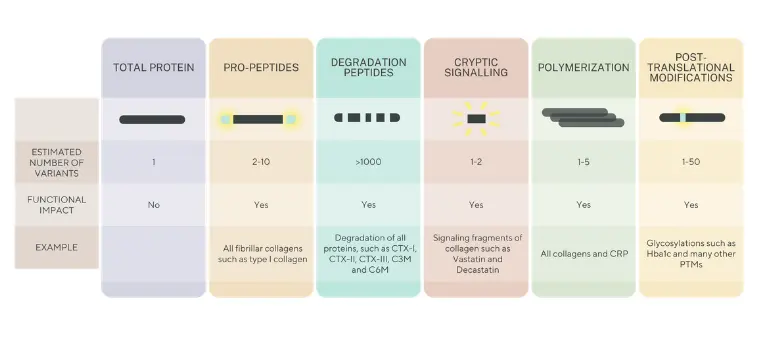
This is the principle behind our Nordic ProteinFingerPrint Technology™. By targeting specific protein fragments generated during extracellular matrix remodeling, the technology is designed to measure defined biological processes rather than total protein abundance alone. This enables a more precise understanding of whether tissue is being formed, degraded, or modified by disease-related enzyme activity, helping researchers connect biomarker measurements to disease mechanisms, progression, and treatment response.
PRO-C3: Journey toward Unicorn Biomarker Status
One example approaching this standard is nordicPRO-C3™. PRO-C3 detects a defined neo-epitope generated during type III collagen formation, linking the measurement to active fibrogenesis rather than total collagen abundance.
Its development has extended well beyond initial discovery. PRO-C3 has demonstrated diagnostic utility as part of the ADAPT score, prognostic value in fibrotic disease and pharmacodynamic utility for measuring treatment-related changes in fibrosis activity. It has also been used extensively in pharmaceutical clinical development.
The launch of Elecsys PRO-C3 by Roche Diagnostics transferred the measurement onto the globally established cobas platform as an IVD-labelled assay. This progression from a biologically defined neo-epitope to a clinically studied and commercially deployed assay is why the paper identifies PRO-C3 as a potential unicorn bomarker.
Why this matters for drug developers
Unicorn biomarkers are valuable to drug developers because they link biological mechanisms with measurable treatment effects. When associated to a clear Context of Use, they can support patient enrichment by identifying individuals with relevant disease activity, disease stage, or risk of progression. This can reduce heterogeneity in trials and improve the ability to detect a meaningful treatment effect.
Their pharmacodynamic utility is especially relevant to drug developers, as they can provide earlier evidence that a therapy is affecting the intended biological pathway before traditional clinical outcomes become visible. This can support proof-of-mechanism, dose selection, treatment monitoring, and go/no-go decisions, helping developers make more informed choices before moving into larger and more costly studies. By providing earlier and more mechanistic grounded information, they can reduce uncertainty, improve trial design, and help lower the risk of late-stage failure.
By combining diagnostic, prognostic, and pharmacodynamic utility with strong scientific, technical, and clinical validation, unicorn biomarkers represent an aspirational standard for biomarker development.
PRO-C3 is not an isolated discovery. It represents Nordic Biosciennce’s approach to biomarker development: begin with biologically meaningful protein fragments and continue through the technical, clinical and regulatory work required to make the measurement useful. We build biomarkers to cross the biomarker valley of death.
Myths and misconceptions about biomarkers
-
While some biomarkers may be subject to biological variability, many others such as NT-proBNP for heart failure or prostate-specific antigen (PSA) for prostate cancer have well-characterized reference ranges and robust assay reproducibility. In fact, standardization and quality control measures have significantly improved the reliability of many biomarker assays.
-
Although oncology has led the way, biomarkers are now well-established in many fields, including cardiology (e.g., troponin for myocardial infarction), hepatology (e.g., ELF or FIB-4 for liver fibrosis) [67], diabetes (HbA1c) and rheumatology (e.g., anti-CCP for rheumatoid arthritis). Their utility spans diagnosis, prognosis, and treatment monitoring across multiple disease domains.
-
While regulatory-grade validation is ideal for clinical implementation (particularly for RLSE or VSE CoUs), exploratory biomarkers can and should be incorporated into early-phase trials to guide hypothesis generation and decision-making and generating data that will enable eventual clinical validation for regulatory use later. Waiting for full validation can delay insights into their potential link to drug MoA or clinical efficacy and hinder development [81]. Further, the use of a biomarker during pre-clinical phases of drug development increases the likelihood of final regulatory approval from 8% to 25%.
-
Although biomarker assays introduce additional costs, these are often small compared with the overall expense of clinical trials. Biomarkers can support clinical development by providing mechanistic insights into treatment response and disease biology, thereby informing critical decisions related to efficacy, safety, and proof of mechanism. As a result, biomarkers may contribute to more efficient and informative clinical trials.
-
When biomarkers have a defined CoU, including their role, target population, and setting, they streamline rather than complicate regulatory pathways. In fact, the FDA’s BEST Resource provides a structured framework for qualifying biomarkers.
Discuss your biomarker strategy
Explore how biologically specific biomarkers could support patient enrichment, proof of mechanism, treatment monitoring or development decisions in your clinical program.