Fibroblast Activity and ECM Turnover | Webinar
February 9, 2026
Fibroblast Activity and ECM Turnover: Biomarkers for Outcomes in Fibrosis and Cancer
Join this webinar to explore why the extracellular matrix (ECM) sits at the center of chronic disease and why fibroblast activity is emerging as a practical, quantifiable lever for prognosis and drug development across fibrosis and oncology.
We will highlight key takeaways from over 700 publications, with a focus on the most decision-relevant insights. We will also showcase registry data from Denmark documenting that:
- 4/10 individuals live with ECM changes
- 1/4 live with fibrosis
- 55% of deaths are linked to diseases involving ECM remodeling
- 40% of deaths are linked to fibrotic diseases
Agenda
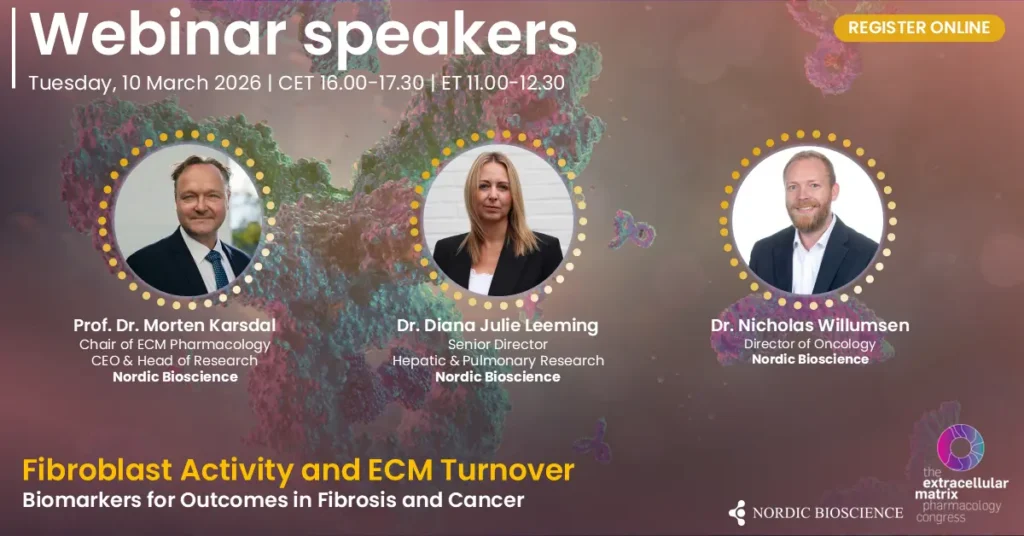
- Welcome and framing: why ECM turnover and fibroblast activity are clinically actionable | moderator Prof. Dr. Morten Karsdal
- Registry evidence and a cross-disease view: how ECM changes and fibrosis translate to outcomes Prof. Dr. Morten Karsdal
- Prognostic power in chronic liver disease: ECM biomarkers with emphasis on PRO-C3 | Dr. Diana Julie Leeming
- Fibroblast activity in solid tumors: CAF biology and collagen type XI, plus broader ECM proteins | Dr. Nicholas Willumsen
- Live discussion and questions from the chat (30 minutes)
Scientific topics
ECM remodeling is not background biology, but rather a measurable disease process that cuts across organ systems and indications. A substantial share of the population lives with ECM changes, and fibrosis remains a dominant contributor to mortality. This webinar focuses on the practical question: how do we quantify fibroblast-driven matrix turnover in a way that predicts outcomes and can guide therapy development?
Across liver, lung, skin, intestinal, cardiovascular, kidney disease, and across solid tumors, fibroblast activity is repeatedly associated with prognosis. Regulatory momentum also reflects this direction: fibroblast activity biomarkers such as PRO-C3 and PRO-C6 (type III and type VI collagen formation) are supported for prognostic use.
We will connect mechanistic framing (what fibroblasts are doing) with translational readouts (what biomarkers capture in blood), then move into two applied deep dives:
- Chronic liver disease: prognostic performance of ECM biomarkers, with emphasis on PRO-C3
- Solid tumors: CAF-linked matrix signatures, including collagen type XI, and how baseline fibroblast activity stratifies survival
Speakers
Prof. Dr. Morten Karsdal
- Dr. Morten Karsdal joined Nordic Bioscience in 2001 and became CEO in June 2010, leading the company to significant advancements in biomarker development and disease biology.
- Dr. Karsdal is a KOL in extracellular matrix research, with more than 700 publication, 44,684 citations, and an impressive H-index of 106.
- Dr. Karsdal is an honorary professor of inflammation research at the University of Southern Denmark, where he continues to supervise PhD students, fostering the next generation of researchers.
- Dr. Karsdal chairs the Extracellular Matrix Pharmacology Congress, an important forum for advancing drug development by focusing on the extracellular matrix (ECM) as a key factor in most chronic diseases. He is renowned for his deep expertise in fibrosis, rheumatology (including rheumatoid arthritis and osteoarthritis), diabetes, and other chronic conditions, particularly in relation to ECM and biomarker research.
- Dr. Karsdal has led the development of FDA-approved and supported molecular diagnostics, as well as more than 100 commercialized biomarker assays, including ELISA assays and high precision automated platforms.
- He has extensive experience in clinical trial design and the clinical application of biochemical markers, often serving as a consultant to major pharmaceutical companies for the use of serological biomarkers in clinical trials.
- In 2016, he and his research team authored the first edition of “Biochemistry of Collagens, Laminins and Elastin,” published by Elsevier Science. The book, now in its 3rd edition as of 2023, is a key resource on collagens and structural proteins, with a focus on their applications in chronic diseases.
Dr. Diana Julie Leeming
- Dr. Diana Julie Leeming is the Senior Director of Fibrosis, Hepatic, and Pulmonary Research at Nordic Bioscience.
- She joined Nordic Bioscience in 2004 and assumed the role of Director of Fibrosis in 2010, later being promoted to Senior Director in 2024.
- Dr. Leeming focuses on developing serologically assessed markers to evaluate extracellular matrix remodeling in patients with pulmonary or hepatic fibrosis, aiding in diagnosis and pharmacodynamic evaluation.
- She is a principal inventor of the PRO-C3 assay, a fibrogenesis marker utilized in multiple clinical trial studies.
- Dr. Leeming has authored over 280 peer-reviewed publications, demonstrating her extensive contributions to the field.
- Her H-index is 69, her I10-index is 195, and her research has garnered over 15,736 citations as of February 2026.
Dr. Nicholas Willumsen
- Dr. Nicholas Willumsen is Director of Oncology at Nordic Bioscience, a position he has held since 2022.
- He joined Nordic Bioscience in 2012 and became Head of the Oncology Department in 2016.
- Dr. Willumsen leads a research group focused on the development of blood-based biomarkers to quantify tumor matrix components in serum from cancer patients.
- His work aims to elucidate pharmacodynamic effects, treatment efficacy, and resistance mechanisms across cancer therapies.
- The group’s research spans the full translational pipeline, from biomarker discovery to preclinical studies and clinical validation.
- A central focus is understanding tumor–extracellular matrix interactions and their role in disease progression and treatment response.
- Dr. Willumsen’s research supports the use of non-invasive biomarkers to guide oncology drug development and clinical decision-making.
- He has authored peer-reviewed publications with an H-index of 31 and an i10-index of 53.
- His work has received 3,246 citations as of February 2026.
This webinar is hosted co-hosted together with the International Society of Extracellular Matrix Pharmacology.