CAFs and the ECM | Webinar
January 26, 2026
Join this ECM Pharmacology Symposium to explore how cancer-associated fibroblasts (CAFs) and the extracellular matrix (ECM) operate as functional units that shape tumor biology — and how these mechanisms can be translated into clinically useful readouts. The session connects mechanistic insights from human pancreatic and breast cancer with emerging non-invasive ECM-derived biomarkers of CAF activity and immune cell dynamics.
Agenda
- Welcome and Introduction (Chair) | Dr. Morten Karsdal — 10 min
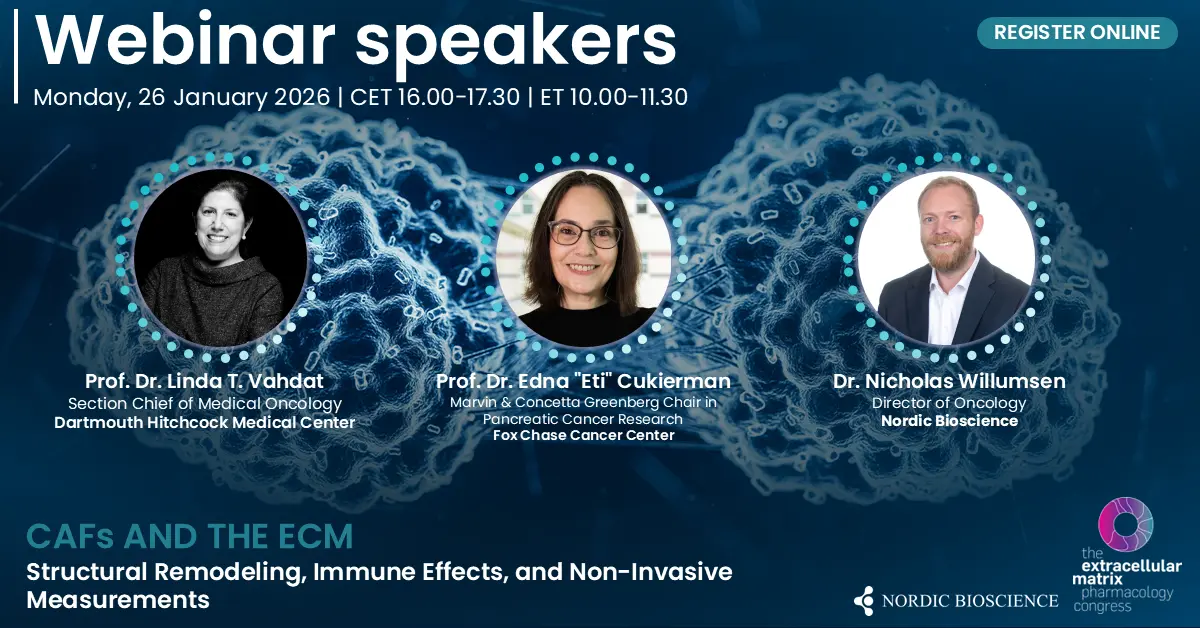
- CAF/ECM Functional Units and Clinical Translation in Human Pancreatic Cancer | Prof. Dr. Edna Cukierman (Fox Chase Cancer Center) — 20 min
- Copper Depletion, ECM/Collagen Remodeling, and Immune Response in Breast Cancer | Prof. Dr. Linda T. Vahdat (Dartmouth Hitchcock Medical Center) — 20 min
- Non-Invasive ECM-Derived Biomarkers of CAF and Immune Cell Activity in Clinical Cancer Research | Dr. Nicholas Willumsen (Nordic Bioscience) — 20 min
- Q&A — 20 min
Scientific topics
CAFs and the ECM do not act as background structure in tumors: they form interacting, measurable functional units that influence tissue mechanics, signaling, and immune context. In pancreatic cancer, these CAF/ECM units are central to how tumors organize their local environment, including ECM deposition and remodeling patterns that can affect therapeutic response and disease behavior, where immune regulation also plays a part of this unit-level biology.
In breast cancer, ECM remodeling, particularly collagen turnover and reorganization, links directly to immune activity and tumor progression. A clinically relevant question is which upstream levers shift ECM remodeling in ways that also alter immune response. This webinar includes insights into how copper depletion can influence collagen remodeling and immune dynamics, with implications for how ECM state may be modified and monitored in patients.
Finally, translation requires measurement. Non-invasive ECM-derived biomarkers offer a practical route to quantify CAF activity and immune cell-associated processes in clinical research. The session covers how circulating ECM fragments can be used as readouts of tumor microenvironment activity, supporting patient stratification, pharmacodynamic monitoring, and hypothesis testing in clinical trials.
Speakers
Prof. Dr. Linda T. Vahdat
- Prof. Dr. Linda T. Vahdat is Section Chief of Medical Oncology and Interim Section Chief of Hematology at Dartmouth Hitchcock Medical Center, and Professor of Medicine at the Geisel School of Medicine at Dartmouth.
- She is a board-certified medical oncologist specializing in breast cancer, with a particular focus on metastatic and triple-negative breast cancer.
- Prof. Dr. Vahdat’s clinical and research mission centers on preventing metastasis and improving survival and quality of life through individualized, research-guided cancer care.
- Her approach emphasizes tailoring therapy intensity to disease stage, aiming for cure with minimal long-term toxicity in early disease and optimal longevity and well-being in metastatic settings.
- She integrates translational research into clinical practice, including investigations into copper biology and its role in cancer progression and metastasis.
- Prof. Dr. Vahdat joined Dartmouth Cancer Center in 2022 and plays a key leadership role in the Comprehensive Breast Program.
- She earned her MD from Mount Sinai School of Medicine, completed residency training at Mount Sinai Hospital, and a Hematology/Oncology fellowship at Memorial Sloan Kettering Cancer Center.
- She also holds an MBA from the MIT Sloan School of Management, reflecting expertise in healthcare leadership and strategy.
- Prof. Dr. Vahdat is committed to patient-centered oncology, prioritizing shared decision-making, education, and empowerment throughout the cancer journey.
- Her work aligns clinical excellence with translational insight to advance outcomes in breast cancer and metastatic disease.
Prof. Dr. Edna Cukierman
- Prof. Dr. Edna Cukierman is the Marvin & Concetta Greenberg Chair in Pancreatic Cancer Research and ACS Wilmott Family Professor of Pancreatic Cancer at Fox Chase Cancer Center.
- She is Co-Leader of the Cancer Signaling and Microenvironment Program and Director of the Spatial Immuno-Proteomic Initiative, specializing in high-plex spatial immunofluorescence.
- Her research centers on the desmoplastic tumor microenvironment (TME) and how cancer-associated fibroblasts (CAFs) and CAF-generated extracellular matrix (ECM) regulate tumor progression.
- Prof. Dr. Cukierman’s laboratory pioneered a unique 3D culture system that mimics in vivo mesenchymal stroma to study functional tumor–stroma interactions.
- She developed Harmonic Output of Stromal Traits (HOST) and the HOST-Factor, a quantitative framework to define functional states of TME cells.
- Her work dissects how CAF–ECM units interact with immune cells, nerves, and cancer cells to drive tumor-supportive or tumor-suppressive behaviors.
- A key focus is evaluating HOST-Factor values as TME-based prognostic biomarkers and predictors of therapeutic response.
- Prof. Dr. Cukierman integrates high-plex spatial immunofluorescence with AI-guided image analysis to generate cell-resolved TME functional maps.
- She has received numerous honors, including AACR TME Working Group Chair (2024–2026), multiple pancreatic cancer foundation awards, and election to leadership roles in the American Society of Matrix Biology.
- Her work aims to enable next-generation ECM- and TME-targeted therapies, directly aligning with translational goals in pancreatic cancer research.
Dr. Nicholas Willumsen
- Dr. Nicholas Willumsen is Director of Oncology at Nordic Bioscience, a position he has held since 2022.
- He joined Nordic Bioscience in 2012 and became Head of the Oncology Department in 2016.
- Dr. Willumsen leads a research group focused on the development of blood-based biomarkers to quantify tumor matrix components in serum from cancer patients.
- His work aims to elucidate pharmacodynamic effects, treatment efficacy, and resistance mechanisms across cancer therapies.
- The group’s research spans the full translational pipeline, from biomarker discovery to preclinical studies and clinical validation.
- A central focus is understanding tumor–extracellular matrix interactions and their role in disease progression and treatment response.
- Dr. Willumsen’s research supports the use of non-invasive biomarkers to guide oncology drug development and clinical decision-making.
- He has authored peer-reviewed publications with an H-index of 30 and an i10-index of 59.
- His work has received 2,824 citations as of June 2025.
This webinar is hosted co-hosted together with the International Society of Extracellular Matrix Pharmacology.