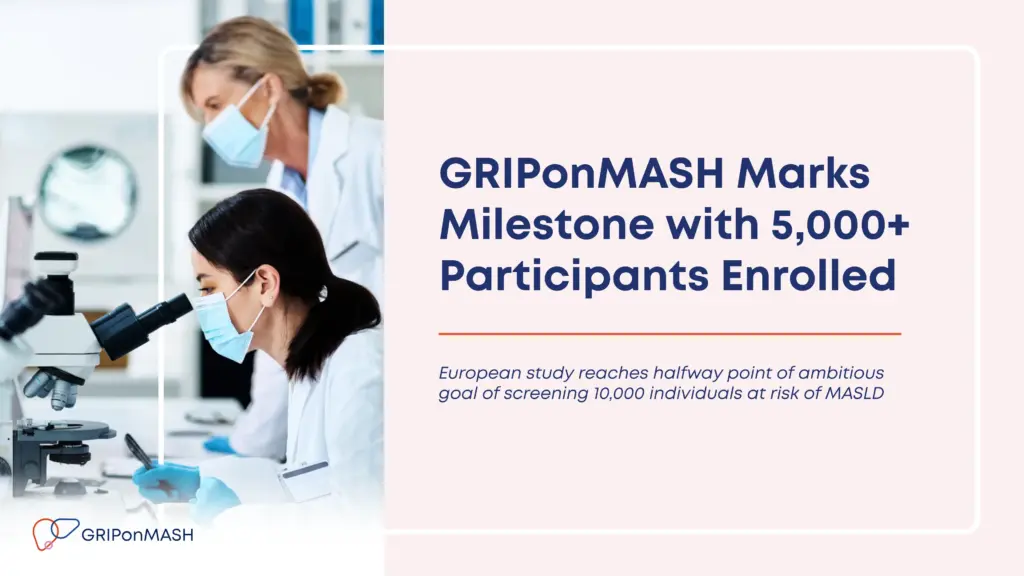
GRIPonMASH Reaches Major Milestone: Over 5,000 Participants Enrolled and 25,000+ Samples Collected Across Europe
May 20, 2026
European study reaches halfway point of ambitious goal of screening 10,000 individuals at risk of MASLD
Utrecht, The Netherlands, May 19, 2026: The GRIPonMASH project has reached a significant milestone in its mission to improve early detection and understanding of metabolic dysfunction-associated steatotic liver disease (MASLD). More than 5,000 participants, representing over 50% of the project’s target, have now been enrolled, alongside the collection of more than 25,000 biological samples for analysis.
This achievement marks an important step toward building one of Europe’s most comprehensive datasets on MASLD, enabling large-scale research into its prevalence, progression, and early identification across diverse populations.
A Pan-European Effort to Advance Liver Health
GRIPonMASH is being carried out in 12 Centres of Excellence across 10 European countries, in collaboration with primary care and outpatient clinics. A full list of participating centres is available below.
Reaching the halfway point is scientifically significant: large-scale participation is essential to understand how MASLD prevalence and progression differ between countries, particularly in relation to cardiometabolic risk factors.
This approach also supports the development of local screening pathways and strengthens collaboration between liver specialists and other healthcare professionals. By operating across multiple countries, the project provides insight into how liver disease presents in different populations and healthcare systems.
“GRIPonMASH is helping redefine how we understand and address liver health across Europe, while generating knowledge with relevance far beyond our region. By uniting expertise, data, and healthcare systems across countries, we are building the evidence needed to shift from late treatment to earlier detection, prevention, and more integrated care, improving liver and cardiometabolic health for populations worldwide,” said Prof. Oscar Franco, Project Lead.
Early Findings Highlight Hidden Disease Burden
Early findings already show the value of this approach. Around 60% of participants screened so far have MASLD (liver steatosis), and about 9% are at risk of significant fibrosis.
Many of these individuals are asymptomatic, highlighting the silent nature of MASLD and the urgent need for structured screening pathways. Identified participants are now being followed up according to local standards of care.
Biobank Enables Next Phase of Research
The collection of more than 25,000 samples, primarily blood, plasma and serum, marks another key milestone.
This growing biobank now makes it possible to begin the first analyses, supporting a better understanding of disease mechanisms and the evaluation of new biomarkers that could improve how patients are identified. Preliminary results will support progress across multiple areas of the project, including the development of diagnostic tools and related research activities.
“Bringing all these samples from the sites to the central biobank is an important achievement and reflects the strong coordination led by the team at Julius Clinical. In the coming period, biochemical data will become available, helping us to better characterise the condition. We are very grateful to our partners who are working extensively in the lab to run these analyses,” noted Scientific Director of GRIPonMASH, Manuel Castro Cabezas.
Driving Innovation in Digital Health
In parallel, three Centres of Excellence are piloting a proprietary Liver Health Management (LHM) platform. Early feedback has highlighted the importance of interoperability with electronic health records, and the platform has recently been updated in line with the latest clinical guidelines.
These efforts represent an important step toward building integrated, scalable solutions for liver disease screening and management.
Looking Ahead
The project is now moving into a phase where recruitment continues alongside the start of preliminary analyses. Efforts across sites are ongoing to further increase participation.
Over the coming year, the focus will be on completing participant enrollment, analysing the first datasets, and further refining screening pathways and supporting tools. These steps will help translate the data collected into practical insights.
In the longer term, GRIPonMASH aims to support earlier and more consistent identification of liver disease in at-risk populations. By strengthening screening approaches and care pathways, the project contributes to improving diagnosis and enabling earlier intervention, with the goal of preventing progression to more advanced stages of disease.
Participating Centres of Excellence
Franciscus Gasthuis & Vlietland, The Netherlands
Amsterdam UMC, The Netherlands
Antwerp University Hospital, Belgium
Hôpital Erasme, Cliniques Universitaires De Bruxelles, Belgium
Universitätsklinikum des Saarlandes, Germany
Hospital Universitario Virgen del Rocío, Spain
Hôpital de la Pitié Salpêtrière, France
Unidade Local de Saúde Santa Maria, Portugal
Fondazione Policlinico Universitario Agostino Gemelli, Italy
Harokopio University of Athens, Greece
General University Hospital Prague, Czech Republic
Sacele Municipal Hospital, Romania
NOTE FOR THE EDITOR, NOT FOR PUBLICATION
About GRIPonMASH
GRIPonMASH is a consortium founded by Julius Clinical (CRO, Zeist, NL) and UMCU (University Medical Center Utrecht) consisting of 27 involved parties dedicated to bring about a transformational change in the detection and diagnosis of MASH patients. The four year project is funded by the Innovative Health Initiative Joint Undertaking (IHI) which is funded jointly by the European Union (represented by the European Commission) and the life science industries (represented by COCIR, EFPIA / Vaccines Europe, EuropaBio, MedTech Europe, Vaccines Europe and Mercodia Aktiebolag, Metadeq Limited and Julius Clinical Research BV). The aim is to achieve better information, diagnosis and lifestyle advice on MASH in order to increase the number of people diagnosed and aware of the lifestyle changes needed and thus decreasing the number of people with MASH and liver cancer.
The project is coordinated by the UMC Utrecht and Julius Clinical in the Netherlands.
Learn more about GRIPonMASH and contributing partners through www.griponmash.eu
For questions, please contact:
Project Management Office
The GRIPonMASH project is supported by the Innovative Health Initiative Joint Undertaking (IHI JU) under grant agreement No 101132946. The JU receives support from the European Union’s Horizon Europe research and innovation programme and COCIR, EFPIA, EuropaBio, MedTech Europe, Vaccines Europe and Mercodia Aktiebolag, Metadeq Limited and Julius Clinical Research BV. Views and opinions expressed are however those of the author(s) only and do not necessarily reflect those of the aforementioned parties. Neither of the aforementioned parties can be held responsible for them.